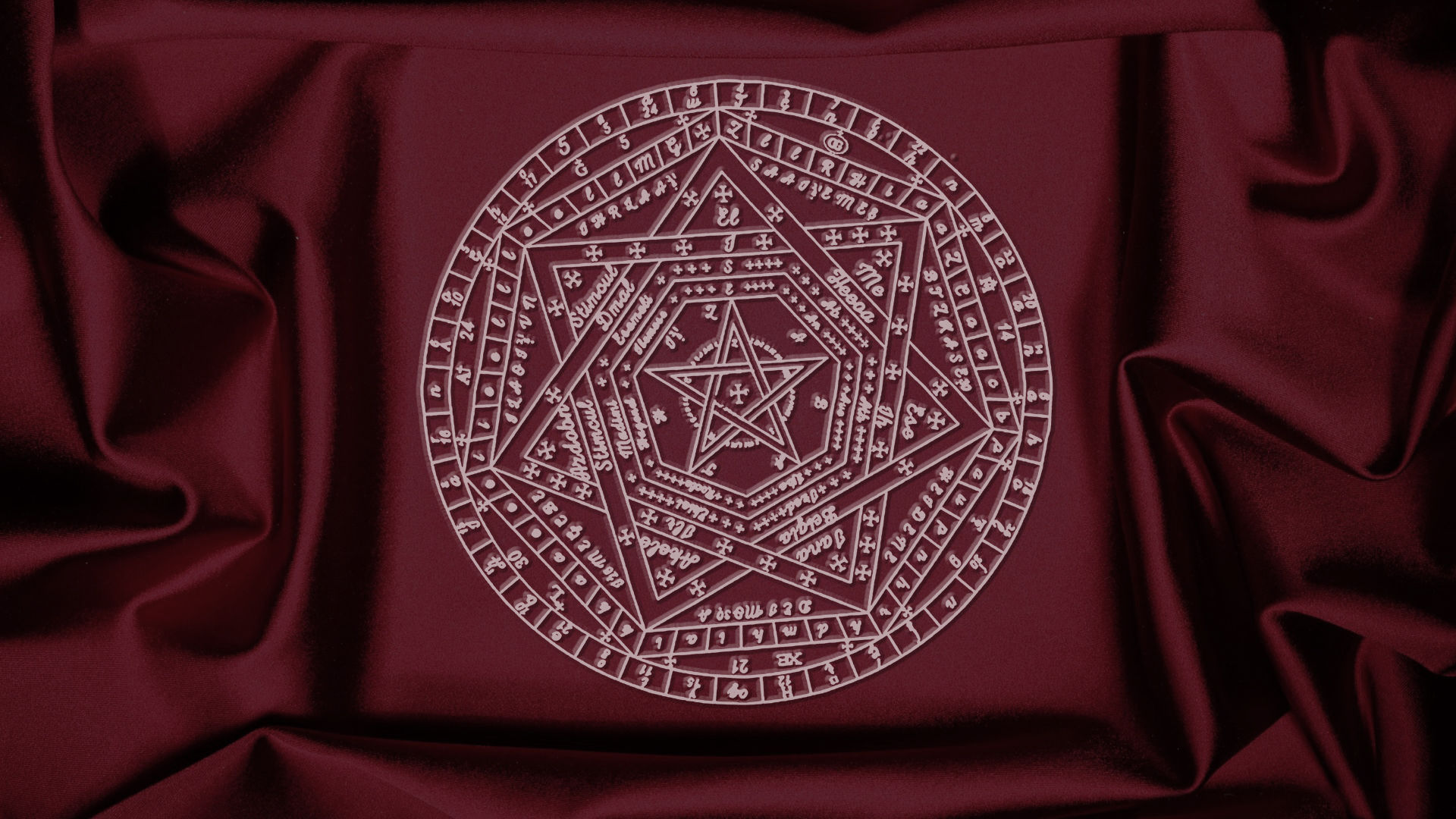


Geomancy
The 16 geomantic figures are the primary symbols used in divinatory geomancy. Each geomantic figure represents a certain formed state of the world or the mind and can be interpreted in various ways based upon the query put forth and the method used to generate the figures. When geomancy was introduced to Europe in the Middle Ages, the figures acquired astrological meanings and new forms of interpretation. The figures bear superficial resemblance to the ba gua, the eight trigrams used in the I Ching or with the Nordic runes.
Geomancy is a form of fortune-telling which was popular in the Middle Ages, and was borrowed directly from the Arab world, where it was called Ilm al-Raml.
European method
Robert Fludd used a variant whose geomantic system consists of 16 figures with four lines each, each of which can have one or two points. The characters all have a name from which an oracle was derived. To hit the oracle, a grid was drawn - either on the ground or on a sheet of paper - in which the various rectangles each correspond to a line of the figures. Without looking, one drew a random number of points on the ground with a stick or on the paper with a pen. Then you counted the points in the respective rectangles, with an odd number corresponding to one point on the figure or an even number corresponding to two points. For each oracle one needed four figures from which one read a prophecy.
Properties of the figures
Each figure has four lines or rows, with each row representing one of the elements; each row can be either active or passive. Above, Puer is shown to have the Fire, Air, and Earth lines active, but the Water line remains passive.
Each of the figures is composed of four lines, each line containing either one or two points. Each line represents one of the four classical elements: from top to bottom, the lines represent fire, air, water, and earth. When a line has a single point, the element is said to be active; otherwise, with two points, the element is passive. Because there are four lines, and since each line can be either active or passive, there are 24, or 16, different figures. The different combinations of elements yields different representations or manifestations of the figure's energy.
Each figure can be said to have a ruling element, whereby that element's energy and manifestations correlates most closely to the figure itself. With the exception of Populus, the ruling element for each figure is always represented as active (a single point in the corresponding line). For figures with only one active element, that element by default is its ruli

--------------------Head - Fire
--------------------Neck - Air
--------------------Body - Water
--------------------Feet - Earth
Ruling Element Figures Ruled
Fire Laetitia, Cauda Draconis, Fortuna Minor, Amissio
Air Puer, Rubeus, Acquisitio, Conjunctio
Water Populus, Via, Albus, Puella
Earth Fortuna Major, Tristitia, Caput Draconis, Carcer
While the elements just described are from the geomantic tradition, another set of elemental assignments are used based on the figures' astrological connections. These elements are assigned based on the zodiac sign of a given figure. The geomantic element is said to reflect the nature of a figure when viewed alone; the astrological element reflects its nature when acting with other figures.
Ruling Element Figures Ruled
Fire Puer, Fortuna Major, Fortuna Minor, Acquisitio, Cauda Draconis
Air Albus, Puella, Tristitia
Water Populus, Via, Rubeus, Laetitia
Earth Amissio, Conjunctio, Caput Draconis, Carcer
Another classification of the geomantic figures involves their quality, which is either stable or mobile. The quality of a figure represents its duration of effect or motion, such that a figure with a stable quality will represent a long-term situation or that a certain object remains where it was left, while a mobile figure represents a transient effect upon the real world. In simple "yes or no" style divinations, stable figures indicate a positive answer, while mobile figures indicate a negative one.
Quality Figures
Stable Acquisitio, Albus, Puella, Populus, Tristitia, Caput Draconis,
Carcer, Fortuna Major
Mobile Laetitia, Cauda Draconis, Amissio, Fortuna Minor, Rubeus, Puer,
Conjunctio, Via
Originally, the quality was shown in terms of entering or exiting figures, where, from the viewer's point of view, the figure would be pointing towards (downward) or away from (upward) the viewer. Entering figures have the stable quality, while the exiting figures have the mobile quality; when an entering figure is rotated upside-down, it becomes an exiting figure, and vice versa. However, based on this classification, the four figures that point in both directions regardless of rotation have the quality of both entering and exiting and must be evaluated in terms of its neighbors or generating figures.
Direction Figures
Entering Acquisitio, Albus, Puella, Tristitia, Caput Draconis, Fortuna Major
Exiting Laetitia, Cauda Draconis, Amissio, Fortuna Minor, Rubeus, Puer
Both Populus, Via, Carcer, Conjunctio
In the generation of the geomantic charts, the primary answer is given by the figure called the Judge. Based upon the mathematics involved in generating the charts, the Judge figure must always have an even number of points. For this reason, all the figures that can appear as Judges (i.e. have an even number of points) are also termed impartial figures; they represent objective states of the world observable equally by any party. The ones with odd numbers of points are termed partial or personal due to their subjective and emotional nature.
Type Figures
Impartial Populus, Via, Carcer, Conjunctio, Amissio, Acquisitio, Fortuna
Major, Fortuna Minor
Partial Laetitia, Tristitia, Rubeus, Albus, Cauda Draconis, Caput
Draconis, Puella, Puer
The History of Geomancy

Mesolithic deer skull headdress from Star Carr
11,000 BC
Museum of Archaeology and Anthropology.
A shaman of the Tungus people of Siberia
Dutch, 1705,
after a drawing by Nicolaes Witsen

‘GEOMANCY’ derives from the Greek words GE, earth, and MANTEIA, divination or prophecy.
There has been an oracular divinatory tradition of geomancy in use for millennia across Arabia, Africa, Europe and Asia.
In some cultures and periods of history the term geomancy has referred to a divinatory system whereby foretelling was done principally by some method of sand or earth casting.
Probably the oldest geomantic traditions currently extant, perhaps dating back 100,000 years, are those of palaeolithic and mesolithic Aboriginal Australia.
Knowledge of local landscape for practical survival reasons such as food, shelter and route finding is intertwined with traditions of landscape creation by Dream-time ancestors, local landscape spirits, sacred sites, cave paintings and ‘song-lines’ across country.
Integral to this knowledge is their proper location-specific and timely ceremonial use for earth magic purposes such as fertility and abundance of food, for education, to maintain the spiritual integrity of the sacred sites and song-lines, and ensure the harmony of the people with their environment and each other.
The neolithic and bronze ages have left a wide legacy of sacred sites across Europe, Asia, Africa and the Americas that reveal in their design advanced knowledge of geomantic precepts.
For many other cultures geomantic practices have also involved direct contact with earth energies, astronomical alignments, sacred geometry, spirit realms, sacred mountains and holy wells etc. as ways of understanding, living in and manipulating the environment.
For them geomantic knowledge was employed as an art and science for better living, dying and worship. These two streams of geomancy have been practiced widely and often concurrently. However it is to the earth divinatory method that the word ‘geomancy’ was first applied.
The earliest styles of divination involved reading cracks in the ground, throwing handfuls of earth onto the ground, striking the sand with a stick to create random patterns, or randomly drawing a number of stones, seeds, or roots, and recording the odd or even numbers of dots generated as a single or two points respectively. Performing this four times generates one of sixteen binary tetragrams – the geomantic tableaux – each with associated meanings and astrological correspondences.
The top line of one or two points is the ‘head’, of the fire element, the second line the ‘neck’ – air element, the third line the ‘body’ – water element, and the bottom line the ‘feet’ – earth element.
Eastern Geomancy
In India Geomancy is called Ramal Shastra. Indian culture has developed a corpus of geomantic knowledge known as Vaastu that may date back to 6000 B.C.E. and was well developed by the time the cities of Harappa and Mohenjo-Daro emerged in the Indus Valley civilisation around 2600 B.C.E.
The Rig Veda (c.2000-1500 B.C.E.) contains early references, and the Vastu Shastras (from 600 C.E.) are Sanskrit manuals for constructing palatial temples and included chapters on home construction, town planning, and how efficient villages, towns and kingdoms integrated temples, water bodies and gardens within them to achieve harmony with nature.
Astronomy, astrology, earth energies, Hindu religion and magic and the science of yantra (geometry) and mantra are woven together to create a cohesive set of architectural precepts for the design of both sacred and secular spaces.

Ramal Shastra Dice
Feng Shui & the I Ching
A Long History of Geomantic Knowledge.
Chinese culture, philosophy, religion and ancient science embodies geomantic knowledge now known as Feng Shui. The earliest archaeological evidence of this is found in the Yangshao and Hongshan neolithic culture sites dated to 5000 B.C.E.
The Ba Gua or Eight Trigrams, a fundamental cycle of both time and space in Feng Shui attributed to Fu Xi (c.3300 B.C.E.), are identical to the Eight-fold Druid Wheel of the Year, suggesting a common origin of metaphysical tradition.
The Ho Tu magic square is also ascribed by tradition to Fu Xi, and the Lo Shu magic square to Wen Wang in 2205 B.C.E.
The sixty-four hexagrams of the I Ching (c. 1150 B.C.E.) are an elaboration of the trigrams from yin-yang, a parallel development to the sixteen tetragrams of Arabic / African / European tradition.
The earliest written reference to Chinese geomantic practice dates back to Emperor Da Yu (c. 2200-2101 B.C.E). Cosmography, astronomy, astrology, numerology, earth energies and landscape topography are woven with Confucian wisdom and Daoist magic into a body of architectural and landscape design as well as ceremonial practice that are used in the design of sacred, governmental and secular buildings and landscapes.
Feng shui is a geomantic tradition that includes written records forming the largest and oldest body of texts on the subject. It has a long continuity of practice, and while some feng shui practices have evolved over time with changes of environment and needs, the original precepts are still very much part of contemporary practice.

Yao Sticks

Classical Period
The legacy of iron age architecture is characterised more by defensive forts that utilise natural topographical features to create places of sanctuary in troubled times, though there is also clear evidence that Celtic cultures establishing political tribal capitals and chose their battlegrounds according to a well-defined geomantically-devised grid system across Europe, and that the Druid colleges of learning were sited at places of geomantic significance.
The Greco-Roman period shows evidence of geomantic design everywhere in the architecture and siting of temples and palaces, as well as wise words from Hesiod (c.700 B.C.E) who instructs us “do not relieve yourselves into sacred springs”.
The ancient Greek schools of learning had links with the later Druids through the Pythagoreans, and documented the geomantic geometry long known to the oral adepts. Euclid’s Sacred Geometry (c. 300 B.C.E.) codified much of this prehistoric knowledge, which was in turn transmitted into the Arabic culture through the Alexandrian library. This is brought alive in the architecture of mosques, and then brought to Europe by the Moors to flourish in medieval Gothic church architecture.
The Romans noted, in their conquest of the Etruscans, standing stones set in linear patterns over the entire countryside of Tuscany.
Romans also record discovering these ‘straight tracks’ in almost every country they subjugated: across Europe, North Africa, Crete, and the regions of ancient Babylon and Nineveh. Roman roads follow these earlier roads, themselves often aligned along global geomagnetic grid-lines.
Arabia and Africa
The Arabs brought these geomantic practices to Africa and variations of it can be found today all over the continent. This system appeared in North Africa by the ninth century, and quickly became one of the standard systems of divination throughout the Arab world. In North Africa it has developed into Afa (Afá in Mina, Fa in Fon) and Ifa in Nigeria (Ifá in Yoruba).


the Oracle of Ifa
Shell Divination

Medieval magic
In the Middle Ages, when geomancy was introduced to Europe where astrology was the foremost occult science, the geomantic figures obtained astrological correspondences to the Zodiac and to the planets. Based on their zodiacal correspondences, astrologers assigned new elemental rulerships (henceforth known as outer elemental rulers, whereas the previous elemental assignments will be known as inner elemental rulers) based on the element of their zodiacal ruler. The exceptions to the planetary rulerships were the figures Cauda Draconis and Caput Draconis, which were assigned to the northern and southern lunar nodes instead.
Medical magic
Medicinal practices in the Middle Ages were often regarded as forms of “natural magic”. One in particular was referred to as a “leechbook”, or a doctor-book that included masses to be said over the healing herbs. For example, a procedure for curing skin disease first involves an ordinary herbal medicine followed by strict instructions to draw blood from the neck of the ill, pour it into running water, spit three times and recite a sort of spell to complete the cure. In addition to the leechbook, the Lacnunga included many prescriptions derived from the European folk culture that more intensely involved magic. The Lacnunga prescribed a set of Christian prayers to be said over the ingredients used to make the medicine, and such ingredients were to be mixed by straws with the names “Matthew, Mark, Luke, and John” inscribed on them. In order for the cure to work, several charms had to be sung in Latin over the medicine.
Charms
Prayers, blessings, and adjurations were all common forms of verbal formulas whose intentions were hard to distinguish between the magical and the religious[citation needed]. Prayers were typically requests directed to a holy figure such as God, a saint, Christ, or Mary. Blessings more often were addressed to patients, and came in the form of wishes for good fortune. Adjurations, the process of making an oath, also used as exorcisms were more directed to either a sickness, or the agent responsible such as a worm, demon, or elf. While these three verbal formulas may have had religious intentions, they often played a role in magical practices. Blessings were more often than not strictly religious as well, unless they were used alongside magic or in a magical context. However, adjurations required closer scrutiny, as their formulas were generally derived from folklore. Though people at this age were less concerned with whether or not these verbal formulas involved magic or not, but rather with the reality of if they were or were not successful.
Sorcery
Not only was it difficult to make the distinction between the magical and religious, but what was even more challenging was to distinguish between helpful (white) magic from harmful (black) magic. Medical magic and protective magic were regarded as helpful, and called ‘white’, while sorcery was considered evil and ‘black’. Distinguishing between black magic and white magic often relied on perspective, for example, if a healer attempted to cure a patient and failed, some would accuse the healer of intentionally harming the patient. In this era, magic was only punished if it was deemed to be ‘black’, meaning it was the practice of a sorcerer with harmful intention.
The Normans and Beyond in Britain
In Britain the conquering Normans, like the Romans before them, employed geomancy to maintain their royal/imperial power, and the royal families and religious institutions of Europe and elsewhere have continued to employ geomancy to assert control and peace over countries.
An example of this is the supplanting of Saxon conical church towers with Norman square crenellated towers of political / religious dominance.
In Scandinavia Geomancy became the Later Norse Futhark. Another offshoot became Napoleon’s Book of Fate.


Vegvisur and Runes

Rune Stones
From Arabia to Europe
The main knowledge of geomancy, as a divinatory art, came to Europe via Arabic texts in the 12th century in Spain, and from there spread across Europe. Its origins may be either Persian or Arabic. The Byzantines also called it Rabolion or Ramplion.
In fact the word geomantia (earth divination) was a direct translation from the Arabic khatt al-raml (sand writing), also known as ‘ilm al-raml (science of the sand) and darb al-raml or zarb al-raml (striking the sand). This last name came from the practice of hitting the sand several times with a stick to read the patterns left behind to decide whether one or two points.

The Medieval Geomantic Instrument
Egypt or Syria, 1241–42 CE, by Muhammad ibn Khutlukh al Mawsuli.
When the dials were turned, random designs of dots would appear, which were then interpreted.
British Museum.
This device, made from brass inlaid with gold and silver, was used to keep a tally of the elements of a geomantic chart.
The four large 90 degree arcs conspicuous on the right-hand side of the device were used to make it more convenient to randomly select the starting information for constructing a geomantic chart.
Ordinarily, when constructing a geomantic chart, one draws sixteen rows of dots at random, in four groups of four. A row with an odd number of dots is represented by * and a row with an even number of dots is represented by * *
A geomantic figure represents four rows of dots, from the top down. Thus, there are sixteen possible geomantic figures.
With this device, the four arcs contain curved sliders bearing all sixteen geomantic figures, and thus sliding them to random positions on this device is used to obtain the starting combination.
The four figures thus obtained are entered on the dials marked I, II, III, and IV, representing the first four houses of the geomantic chart. Like the houses of a horoscope, they cover different topics, to which the geomantic figure located in the house is applied.
The dials are so designed that turning the pointer on a knob to the name of a geomantic figure places its picture in the window above the dial. When the dial is pointed at the open window, it is in a neutral position, and the window is blank.
Renaissance

Meteorological Divination by Robert Fludd

Geomantic Divination Dice


In Europe the divinatory system was widely practiced during the Middle Ages and Renaissance, and in the latter period Henry Cornelius Agrippa, Robert Fludd and John Heydon wrote significant works on this divination method, drawing on medieval and European and Arabic works on the subject, in which the basic techniques of geomantic divination had been expanded and applied in a vast range of ways, incorporating many astrological elements.
The word ‘geomancy’ during this period referred to this specific method of divination using sixteen figures formed of four lines of one or two points.
The medieval stonemasons’ work encodes geometry, metrology, acoustics, astronomy, earth energies, mythology and magic in the great Gothic Cathedrals of Europe. The landscape was significantly redesigned using geometric principles in the middle ages by the Cathars, Knights Templar and the Holy Church of Rome.
In his 1538-43 ‘Itineraries’ Henry 8th’s antiquarian surveyor John Leland enquired of Morris dancers from where their inspiration came for the complex dances they performed, to be told ‘from the mysterious grass circles that appear in our fields in summer-time’.

Heinrich Cornelius Agrippa (1486-1535)
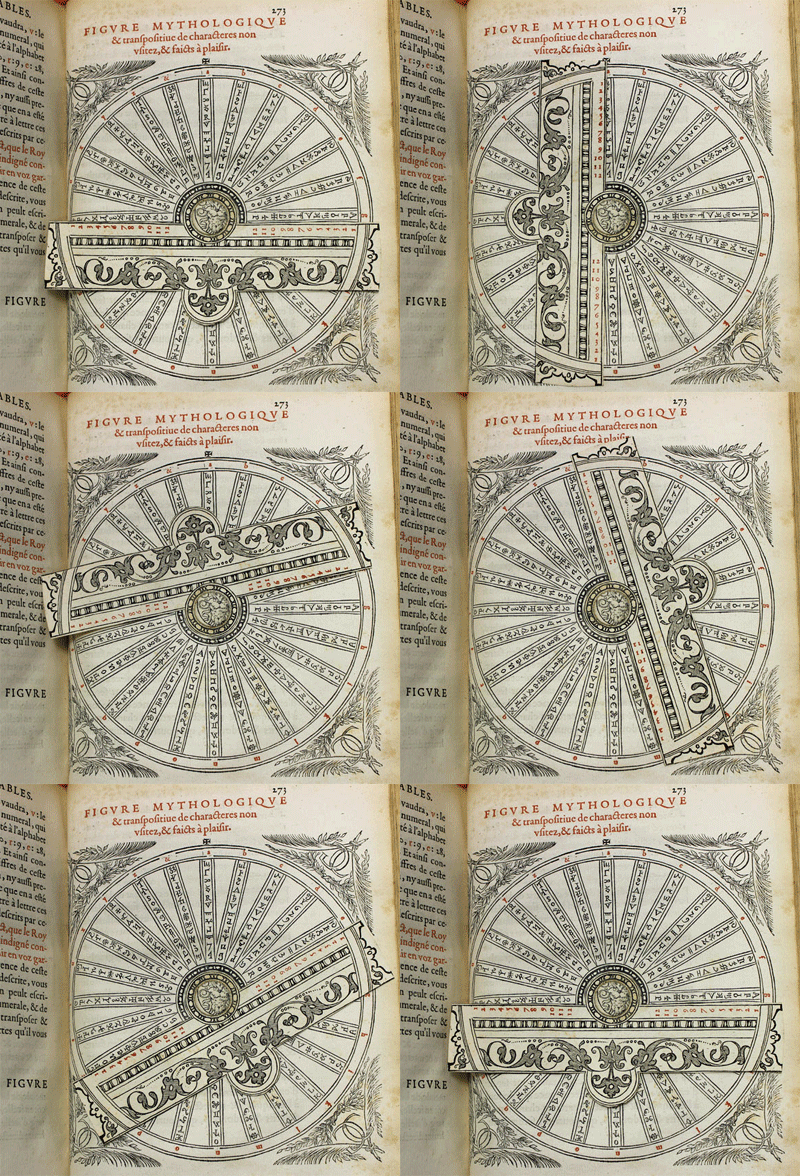


Dr. John Dee
Geomancy Integrated with Astrology & Alchemy
John Dee (13 July 1527 – 1608 or 1609) was an English mathematician, astronomer, astrologer, teacher, occultist, and alchemist. He was the court astronomer for, and advisor to, Elizabeth I, and spent much of his time on alchemy, divination and Hermetic philosophy. As an antiquarian, he had one of the largest libraries in England at the time. As a political advisor, he advocated for the founding of English colonies in the New World to form a "British Empire", a term he is credited with coining.
Dee eventually left Elizabeth's service and went on a quest for additional knowledge in the deeper realms of the occult and supernatural. He aligned himself with several individuals who may have been charlatans, travelled through Europe, where in Antwerp, he met Edward Kelly. Later, he was accused of spying for the English crown. Upon his return to England, he found his home and library vandalised. He eventually returned to the Queen's service, but was turned away when she was succeeded by James I. He died in poverty in London and his gravesite is unknown.
Science and sorcery
To 21st-century eyes, Dee's activities straddle magic and modern science, but the distinction would have meant nothing to him. He was invited to lecture on Euclidean geometry at the University of Paris while still in his early twenties. He was an ardent promoter of mathematics, a respected astronomer and a leading expert in navigation, who trained many who would conduct England's voyages of discovery.
Meanwhile, he immersed himself in sorcery, astrology and Hermetic philosophy. Much effort in his last 30 years went into trying to commune with angels, so as to learn the universal language of creation and achieve a pre-apocalyptic unity of mankind. A student of the Renaissance Neo-Platonism of Marsilio Ficino, he drew no distinctions between his mathematical research and his investigations of Hermetic magic, angel summoning and divination: all his activities were part of his quest for a transcendent understanding of divine forms underlying the visible world: Dee's "pure verities".
Dee amassed one of England's biggest libraries. His scholarly status also took him into Elizabethan politics as an adviser and tutor to Elizabeth I and through relations with her ministers Francis Walsingham and William Cecil. He tutored and patronised Sir Philip Sidney; his uncle Robert Dudley, 1st Earl of Leicester; Edward Dyer; and Sir Christopher Hatton.
18th Century – A Druidic Revival
In 1740 the antiquarian Dr. William Stukeley first noted that the axis of Stonehenge and the Avenue leading from it point to the north-east, ‘whereabouts the sun rises when the days are longest’.
He perceived the whole British landscape as laid out according to a sacred ‘druidic’ pattern, and etched with symbols of serpents and winged discs such as at Avebury.
At Barrow near Hull he found a great earthwork representing a winged circle, its trenches arranged so as to measure the seasonal tides of the Humber Estuary, and found another near Navestock Common in Essex ‘…They have made plains and hills, valleys, springs and rivers contribute to form a temple three miles in length…They have stamped a whole country with the impress of this sacred character’.
He was active in the druid revival (which began in 1717 along with a number of other magical societies) which returned to performing ceremony at the old Neolithic and Bronze age sacred sites.


Megalithic Monument in Werix, Belgium
Megalithic temples and processional routes, standing stones and stone circles, pyramids, conical mounds and chambered cairns show evidence of a widespread and consistent understanding of sacred geometry and metrology, astronomical alignment to sun, moon and star rising and setting orientations, leylines, global geomagnetic grids, and underground water veins.

John Mullins, one of the best dowsers in England (died 1894)

The 19th & 20th Century
The Earth Mysteries are Rediscovered
The twentieth century saw a burgeoning of interest in Europe in rediscovering the geomantic mysteries of the past.
The archaeoastronomer Norman Lockyear explored astronomical alignment and sacred geometry at sacred sites in Greece, Egypt and Britain in the late eighteen and early nineteen hundreds, and found alignments such as the Ley running from a round barrow north of Stonehenge near the cursus, through Stonehenge, Old Sarum, Salisbury cathedral and two further Iron age hill-forts.
In the 1920s Alfred Watkins first became aware of the alignment of ancient British sites in the early 1920’s, in what he described as ‘a flood of ancestral memory’. He coined the term Ley to describe these paths across the landscape that include mounds, long-barrows, cairns, cursus, dolmens, standing stones, mark-stones, stone circles, henges, water-markers (moats, ponds, springs, fords, wells), castles, beacon-hills, churches, cross-roads, notches in hills, camps and hill-forts.
Joseph Heinsch and Wihelm Teudt echoed this research into Holy Lines and astronomical aligments in the landscape in Germany, both published in 1929.
Reginald Allendar Smith’s major contribution to the Earth Mysteries field was to first publish articles in the British Society of Dowsers journal in the 1930s reporting that he was consistently finding water under the same ancient sacred sites that were exciting the Ley hunters.
The engineer and archaeoastronomer Alexander Thom published between the 1950s and 1980s a vast body of research into the astronomical alignments of neolithic sacred sites across Britain, Ireland and France.
He showed through vigorous research that the length of 2.72 ft – the Megalithic Yard – was a common unit of measurement in the geometry of many megalithic monuments.
He also found a smaller common unit of measurement in the spiral carvings on certain megaliths and concluded that the megalithic builders were sophisticated astronomers engaged in a detailed study of the movements of the heavenly bodies, incorporated into their structures over a long period of observation.
Sikidy & Mpisikidy
In Madagascar, this microcosmic divinatory system, known as Sikidy, is integrated under the title Vintana or ‘Fate’ with astrology and a macrocosmic geomancy that incorporates sacred wells, caves, cairns, standing stones and traditional straight trackways.
Queen Ranavalona I of Madagascar was cited by missionaries as the epitome of ‘superstition’ as she employed Mpisikidy (geomancers) to define her every move, perhaps the last of the sacral monarchs who lived entirely according to the ancient canonical way of life. She would only perform the correct acts of the day, observed the lucky and unlucky colours of the day, sat in the correct place in the palace for the hour and day, and journeyed only to those places geomantically correct for the astrological aspects of the time.

Sikidy sorcerer predict future events - 1900

La divination par les graines chez les Hova, Madagascar
Voodoo & Hoodoo
Voodoo in popular culture encompasses various representations of practices associated with different forms of voodoo, including Haitian Vodou and Louisiana Voodoo, and other elements attributed to African diaspora religions, with such representations often deviating substantially from any actual voodoo practices or beliefs. Tropes regarding voodoo appear most often in supernatural fantasy or horror films, with common themes including the activity of witch doctors, the summoning or control of dark spirits, use of voodoo dolls to inflict pain on people remotely, and the creation of zombies.
Hoodoo is a set of spiritual practices, traditions, and beliefs which was created and concealed from slaveholders by enslaved Africans in North America. Hoodoo evolved from various traditional African religions and practices, and in the American South, incorporated various elements of indigenous botanical knowledge. Hoodoo is an African Diaspora tradition created during the time of slavery in the United States, and is an esoteric system of African-American occultism. Many of the practices are similar to other African Diaspora traditions as the practices come from the Bakongo people in Central Africa. During the transatlantic slave trade, about 40 percent of Africans taken to the United States were Bantu-Kongo. Hoodoo is a syncretic spiritual system that combines Christianity that was forced on enslaved Africans, Islam brought over by enslaved West African Muslims, and Spiritualism. This tradition is part of the African-American cultural heritage of spirituality and religion. Following the Great Migration of African-Americans, Hoodoo spread throughout the United States. Practitioners of Hoodoo are called rootworkers, conjure doctors, conjure man or conjure woman, root doctors, Hoodoo doctors, and swampers. Regional synonyms for hoodoo include conjure or rootwork.

Voodoo Dolls
La divination par les graines chez les Hova, Madagascar
Historical figures
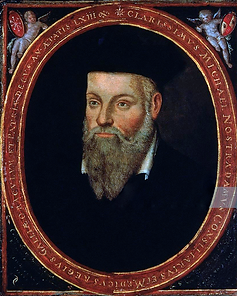
Nostradamus
Generating the geomantic charts
A shield chart. The Mothers are, right to left, Via, Acquisitio, Conjunctio, and Laetitia.
While the Reconciler is not pictured, it would be Amissio in this case.
Geomancy requires the geomancer to create sixteen lines of points or marks without counting, creating sixteen random numbers. Without taking note of the number of points made, the geomancer provides the seemingly random mechanism needed for most forms of divination. Once the lines are produced, the geomancer marks off the points two by two until either one or two points remain in the line; mathematically, this is the same as producing two dots if the number is even or one dot if the number is odd. Taking these leftover points in groups of four, they form the first four geomantic figures, and form the basis for the generation of the remaining figures. Once this is done, the "inspired" portion of the geomantic reading is done; what remains is algorithmic calculation.
Traditionally, geomancy requires a surface of sand and the hands or a stick, but can be done equally well with a wax tablet and stylus or a pen and paper; ritualized objects may or may not be desired for use in divination.
Often, when drawing marks or figures, geomancers will proceed from right to left as a tradition from geomancy's Arabic origins, although this is by no means mandatory.
Modern methods of geomancy include, in addition to the traditional ways, computerized random number generators or thrown objects; other methods including counting the eyes on potatoes. Some practitioners use specialized dice or cards, with each card representing a single geomantic figure; in this case, only four cards are drawn after shuffling. Specialized machines have also been used to generate full geomantic charts.
The figures are entered into a specialized table, known as the shield chart, which illustrates the recursive processes reminiscent of the Cantor set that form the figures. The first four figures are called the matres, or Mothers, and form the basis for the rest of the figures in the chart; they occupy the first four houses in the upper right-hand corner such that the first Mother is to the far right, the second Mother is to her left, and so on (continuing the right-to-left tradition).
The next four figures, the filiae, or Daughters, are formed by rearranging the lines used in the Mothers: the first Daughter is formed by taking the first line from the first, second, third, and fourth Mothers in order and rearranging them to be the first Daughter's first, second, third, and fourth lines, respectively. The process is done similarly for the second Daughter using the second line from the Mothers, and so on. The Daughters are placed in the next four houses in order on the same row as the Mothers.
After the eight matres and filiae are formed, the four nepotes (or Nieces) are formed by adding those pairs of figures that rest above the houses of the respective Niece. Therefore, the first and second Mothers add to form the first Niece, the third and fourth Mothers add to form the second Niece, and so on. Here, addition involves summing the points in the respective lines of the parents: if the sum is an even number, then the resulting figure's line will have two points, and if the sum is odd then the line will have one point. Conceptually, this is the same procedure in mathematical logic as the exclusive or, where a line with two points is used instead of "false" and a line with one point instead of "true".
From the four nepotes, the two testes (or Witnesses) are formed in the same manner as the nepotes: the first and second Nieces form the Right Witness, and the third and fourth Nieces form the Left Witness. From the Witnesses, using the same addition process, the iudex, or Judge, is formed. A sixteenth figure, the Reconciler or superiudex, is also generated by adding the Judge and the First Mother, although this has become seen as extraneous and a "backup figure" in recent times.

Interpreting the charts
The shield chart most likely provided an early visual guide to generating the figures, and the interpreted answer would center on the fifteenth and sixteenth figures, the Judge and Reconciler. Skilled geomancers observe the whole chart, interpreting (among other things) meanings of the figures based on where they place in the chart, the numerical significance of the total points, and the similarities produced by added figures. Generally, the Judge represents the answer to the question, the Right Witness describes the querent's side of the query, the Left Witness represents the quesited's side, and the Reconciler represents the effect of the outcome (or Judge) upon the querent. The skilled geomancer can deduce root causes to the situation, hidden influences, the outcome and its aftermath, and general trends and events in the querent's life through interpreting the chart.
One division of the shield chart for interpretation involves triplets of the figures called triplicities. Each triplicity contains two of the Mothers or two of the Daughters and the Niece that results from them. They can be interpreted in a manner similar to the Witnesses and Judge, in that the right parent represents the past, the child the present, and the left parent the future; another way to interpret such a triplet views the right parent as the querent's side, allies, resources, and opinions, the left parent as the quesited's side, and the child as the interaction of the two sides.
Triplicity Figures Involved Interpretation
First Triplicity First Mother, Second Mother, First Niece The querent's health, disposition,
outlooks, and habits.
Current trends in the querent's life.
Second Triplicity Third Mother, Fourth Mother, Second Niece The influences in the querent's life at the time of the reading.
Factors that shape the querent's
life and the situation surrounding
the query.
Third Triplicity First Daughter, Second Daughter, Third Niece The places most frequented by the querent,
including the home and the workplace.
People and objects found at those places.
Family, partners, and housemates of the querent.
Fourth Triplicity Third Daughter, Fourth Daughter, Fourth Niece Friends, associates, coworkers, colleagues of the
querent, as well as people in authority over the
querent. Situations and factors caused
by external sources.
Another method of evaluating a geomantic chart involves taking the total sum of all points from 16 figures within the shield chart. In order to evaluate how quickly the queried situation would resolve, Pietro d'Abano suggested that the total sum be compared to the sum of all points in the sixteen geomantic figures, which is 96. If the sum of the chart is 96, then the resolution of the query will be "swift, and neither slow nor doubtful;" in other words, that all things that could be acted upon in the situation described by the query would resolve without delay nor ahead of schedule. If the sum is less than 96, then it will resolve quickly, and in a degree proportional to the difference between 96 and the total. Conversely, if the sum is more than 96, then it will resolve slowly.
The house chart corresponding to the shield chart above. The Witnesses, Judge, and Reconciler are not shown.
European geomancers provided an alternate method of interpreting the figures through the house chart, which feature the twelve astrological houses. Here, they assign the figures from the shield chart to the houses in the house chart; the order used differs between different circles of occultists. While European geomancers still used the shield chart to generate the figures and provide most answers, they augmented geomancy with astrological techniques in the house chart. Based upon the query, they could provide a deeper insight into the querent's life, factors shaping the query itself, and the extent of the situations involved. They took note when several houses shared the same figure; as this figure passes from one house to the next, it generally indicates that the same situation or event affects each of those houses.
Pietro d'Abano discusses the primary modes of perfection used in geomantic interpretations with significators in his geomancy essay. In astrological geomancy, the significators are chosen based upon the identity of the querent and the identity of the quesited. Generally, except when the querent asks about a situation about a subject with no immediate connection to themselves, the querent's significator is located in the first house (see Derivative house).
The quesited's significator is identified based upon the focus of the query: this is based upon the relation of the query to the astrological houses. Some questions require more than two significators, such as in a query involving several primary factors (e.g., two parties quarrelling over an estate). Queries that have a yes-or-no, or possible-impossible, answer can easily be answered with these modes of perfection. If the chart perfects, the answer is "yes". Otherwise, in the case of denial of perfection, "no".
The nature of the figures themselves should also be considered. If a chart perfects with negative figures, for instance, the matter will resolve but the querent may not like the result. On the other hand, if the chart does not perfect but the figures are good, then the matter will not resolve even though the querent can make do successfully without it.
All and all, this oracle's significance depends mainly on the intuition and interpretation of the reader, as in all oracles.
Throwing Dice

Druid Sticks
Druid Sticks
Druid sticks have been used and are still being used in many forms of divination around the world. Many cultures have systems of divination that produce a series of tetragrams. I-ching is another form although there are more variations. The Druid Sticks produce a total of 16 tetragrams.
To use the Druid Sticks, prepare an area for reading. If you have a cloth that you use for your Tarot deck, it can be used for the Druid Stick reading. Hold the four Druid Sticks in your hands, mix them together and meditate on your question. Blow gently over the sticks and cast them onto the cloth. Keep one hand covering the sticks while you align the sticks into neat rows. By observing the pattern created by the lines on each of the sticks, you will receive your answer.

Ghoreh Dice
In India, a simpler method of choosing geomantic figures at random is commonly used. A set of four special four-sided dice is joined together by a rod as illustrated above, called ghoreh dice.
The order of symbols on each die is not fixed, but below the perspective drawing, the two basic arrangements (the first of which is more common) are shown.
One way to use these dice is to take an odd number as representing a single dot, and an even number as representing two dots, and thus one can generate a geomantic figure in one roll.
Another option, applicable only to the first arrangement of the dice, as shown on the left, is to take the symbol on each die as representing two rows of a geomantic figure. In that case, only two rolls are required to generate all four of the figures required to draw a complete geomantic chart; for example, one roll to produce the tops of all four figures, and then another roll to produce the bottoms of all the geomantic figures.
Note that there is no obvious indication of which end of the set of Ramala dice is occupied by the first die; it may be read simply however it appears to the caster, or it may be thrown so that while the dice spin randomly, the orientation of the set as a whole is not likely to change.
Note, however, that the account of how these dice are used by Stewart Culin, on page 65 of the Proceedings of the Numismatic and Antiquarian Society of Philadelphia for 1890 and 1891, published in 1892, involves instead looking up their total in a book of divination. However, an Indian book entitled Ramala Nauratna does indeed describe geomancy, as might be expected by the similarity between the names Ramala and Ilm al-Raml.
The Planets
Traditionally, the energies and manifestations of the planets were different based on their declination or motion; for the planets Mercury, Venus, Mars, Jupiter, and Saturn, the diurnal energy represents the planet in direct motion, while the nocturnal energy refers to the retrograde motion of the planets. For the Moon, this was illustrated by the waxing or waning periods of the Moon, respectively; the Sun's figures were based on the Sun during the day (or northern declination) or during the night (southern declination). The zodiacal rulerships followed from the diurnal or nocturnal planetary rulership: nocturnal figures are assigned earth and water signs, while diurnal figures are assigned fire and air signs. The North Node is assigned, by Gerard of Cremona, to Sagittarius and the South Node to Virgo (for the sake of finding the ascendant in astrological traditions of geomancy). Once the zodiacal rulerships were agreed upon, all the following correspondences followed upon the geomantic figures, including what part of the body they each ruled over, different countries, planetary hours, body and character types, and so on.

Planet Diurnal figure Nocturnal figure
Sun Fortuna Major Fortuna Minor
Moon Populus Via
Mercury Albus Conjunctio
Venus Puella Amissio
Mars Puer Rubeus
Jupiter Acquisitio Laetitia
Saturn Tristitia Carcer
Lunar nodes Caput Draconis Cauda Draconis
Operations of the figures
Addition of figures
The structure of the figures themselves can be directly translated into binary numbers, such as those used by modern computers, with passive lines representing the numeral 0 (or logic low) and active lines representing the numeral 1 (or logic high). This structure is exploited in computation of more figures by means of the XOR function used widely in computer science and electrical systems; when two figures are "added" to form a new figure (where points in the lines of the same elements are summed, divided by two, and the remainder taken), the logical operation obtains the new figure by determining which lines are different. The lines that have different numbers of points results in a line with one point (logic high), and lines with the same number of points results in a line with two points (logic low). The result of adding two figures is usually interpreted to mean the interaction between the two parties (the parent figures) or the present situation (when one parent represents the past and the other parent represents the future).
Inversion of figures
In the same fashion how Boolean values or binary numbers can be inverted, geomantic figures can likewise be inverted. By inversion, figures whose lines are active become passive and vice versa. In this manner, Puer becomes Albus, Populus becomes Via, and so forth. Inversion represents a polarity of action, e.g. the rashness of Puer balanced by the calmness of Albus.
Reversion of figures
Reversion, or rotation, of figures is the process that replaces the fire line of a figure with the earth line, the air line with the water line, and vice versa. By reversion, Puer and Puella are reverted pairs, as are Rubeus and Albus. Not all figures have a unique reversion: the figures that are neither entering nor exiting revert into themselves and the other figures with even points revert into their inverted figure. Reversion often represents an axial polarity, such as the male and female axis between Puer and Puella.
Geomancy and mathematics
The four binary elements of each figure allow for 16 different combinations, each called a tableau. As each chart is generated from the four Mothers, there are a total number of 164, or 65,536, possible charts. Due to the mathematics of the chart, only figures that have an even number of points total can become Judges;[12] each of the eight Judges then has 8,192 charts associated with it. Traditional practitioners of geomancy use this knowledge as a type of parity check on the chart to ensure that no mistakes have been made while computing the figures.
In each chart, if all sixteen figures are observed (the four Mothers, the four Daughters, the four Nieces, the Witnesses, Judge, and Reconciler), at least two of the figures must be the same. As the Reconciler is usually termed an optional figure, 16 combinations of Mother figures can yield a chart where the Mothers, Daughters, Nieces, Witnesses, and Judge are all unique.
Populus cannot appear in these charts, since mathematically it either requires two figures to be the same in order to be formed, or produces a duplicate figure when added to another figure. In such charts, the Judge will always be one of Conjunctio, Amissio, Carcer, or Acquisitio. The sixteen combinations of Mothers, in order from the First to the Fourth Mother, are:
-
Puer, Caput Draconis, Tristitia, Albus
-
Conjunctio, Puella, Fortuna Major, Tristitia
-
Puella, Puer, Tristitia, Albus
-
Puella, Cauda Draconis, Tristitia, Albus
-
Rubeus, Laetitia, Puella, Puer
-
Rubeus, Laetitia, Cauda Draconis, Puella
-
Rubeus, Laetitia, Cauda Draconis, Caput Draconis
-
Rubeus, Laetitia, Caput Draconis, Puer
-
Acquisitio, Puella, Albus, Fortuna Major
-
Laetitia, Fortuna Minor, Puer, Conjunctio
-
Laetitia, Fortuna Minor, Acquisitio, Cauda Draconis
-
Cauda Draconis, Caput Draconis, Tristitia, Albus
-
Caput Draconis, Amissio, Fortuna Major, Tristitia
-
Caput Draconis, Carcer, Albus, Fortuna Major
-
Fortuna Minor, Rubeus, Puer, Amissio
-
Fortuna Minor, Rubeus, Carcer, Cauda Draconis
The Geomantic Figures

Via
Latin for "the Way". The figure resembles a road or path. It is considered bad of most things, but good with concerns of roads, travels, or journeys. Astrologically it is associated with Cancer and the waning Moon and both its inner and outer elements are water. All the elements in Via are active and as such the figure indicates change more than any other figure. Regarding the outcome of the situation being divined, it is neutral, unless change by itself infers a positive or negative result. This figure inverts any figure when added, giving it another meaning of change. Its planetary ruler is Chashmodai, its Intelligence is the Intelligence of Intelligences Malkah beTarshishim ve-ad Ruachoth Shechalim, and its Spirit is the Spirit of Spirits is Shad Barshemoth ha-Shartathan. It is associated with the deities Diana and Mercurius and the angels Gabriel and Muriel. It is associated with the stomach.
Cauda Draconis
Latin for "the Tail of the Dragon" and the figure of the south node of the Moon. It is considered very bad in most situations, such that in older traditions if this was the first figure drawn the geomancy reading was stopped. It is only good in circumstances for ending or completing things, such as breaking up a relationship. It brings good with evil, and evil with good. It is associated with the malefic planets Saturn and Mars and the astrological sign Virgo. Its inner and outer element are both fire. Its planetary intelligences are Agiel and Graphiel and its spirits are Zazel and Bartzabel; it is associated with the deities Mavors, Saeturnus, and Athena, and the angels Cassiel, Samael and Malchidael. It is associated with the left arm.


Puer
Latin for "the Boy". The figure is a representation of a sword or erect phallus and refers to male energies, primarily aggression and passion, but also war and male sexuality. It is bad in most cases, but good in situations where boys (in Antiquity and Medieval society) excelled: love and war. Astrologically it is associated with Aries and Mars. All elements are active except Water, the element of emotion; its inner element is air, but due to it being ruled by Mars, its outer element is fire. Its planetary intelligence is Graphiel and its spirit is Bartzabel; it is associated with the deities Mavors and Athena and the angels Samael and Malchidael. It is associated with the head.
Fortuna Minor
Latin for "the Lesser Fortune". The figure is symbolic of success coming down like beams of light from the Sun. Astrologically it is associated with Leo and the Sun in southern declinations; both its inner and outer elemental rulers are fire. It indicates a weakly positive outcome in nearly all questions, representing transient success that is dependent upon outside help. It favors situations that can be resolved quickly and do not need to be sustained. It is a figure of change and instability. Its planetary intelligence is Nakhiel and its spirit is Sorath; it is associated with the deities Apollo and Jupiter and the angels Michael and Verchiel. It is associated with the spine.

Puella
Latin for "the Girl". The figure is to resemble the vulva or a woman with exaggerated breasts. It is good in most situations, especially with women, beauty, or feminine situations. Astrologically it is associated with Libra and Venus; its outer element is air, but its inner element is water. It represents peace and passivity, which can be either positive or negative depending on the question being answered, though generally positive, requiring to be acted upon instead of it acting on a situation. It is the symbol of feminine sexuality, balancing the energy of Puer. Its planetary intelligence is Hagiel and its spirit is Kedemel; it is associated with the deities Venus and Vulcanus and the angels Anael and Zuriel. It is associated with the kidneys, lower back, buttocks, and skin.


Amissio
Latin for "Loss". The figure is of two bowls or cups turned upside-down. Astrologically, it is associated with Taurus and Venus retrograde. Its inner element is fire but ruled outwardly by earth. In general, the figure is bad or negative figure for all charts except those for love (being a figure of Venus) or where loss is desired and denotes loss. Often it represents something outside of one's grasp. Its planetary intelligence is Hagiel and its spirit is Kedemel; it is associated with the goddess Venus and the angels Anael and Asmodel. It is associated with the neck and throat.
Carcer
Latin for "the Prison". The figure is the outline of an enclosure, a link in a chain, or prison cell. It is usually bad in situations and denotes delays, setbacks, or bindings. Astrologically it is associated with Capricorn and Saturn retrograde; its inner and outer element is earth. It refers to immobility, and also thereby strength. Depending on the question it could indicate a restriction or a source of willpower. It is generally unfavourable, but can be favourable in questions involving stability or security. Its planetary intelligence is Agiel and its spirit is Zazel; it is associated with the deities Saeturnus and Vesta, and the angels Cassiel and Hanael. It is associated with the knees and skeletal system of the body.

Laetitia
Latin for "Joy". The figure resembles an arch, fountain, or rainbow. It is good in situations that concern potential, joy, or happiness. Astrologically it is associated with Pisces and Jupiter retrograde. It is ruled externally by water, but inwardly by fire. It is a positive figure for nearly all questions, representing fast situations and construction. It indicates upward motion, happiness, or joy. Its planetary intelligence is Iophiel and its spirit is Hismael; it is associated with the deities Jove and Neptunus, and the angels Sachiel and Barchiel. It is associated with the feet.

Caput Draconis
Latin for "the Head of the Dragon". The figure resembles the astrological symbol the north node of the Moon. It is neutral figure (good with good, evil with evil) but fortunate with starting or beginning new things. It is favourable for beginnings and profit, and otherwise favourable with other favourable figures, and unfavourable with unfavourable ones. It is associated with the benefic planets Jupiter and Venus, and assigned to the zodiac sign of Sagittarius; its outer element is fire due to its association with Sagittarius while its inner element is earth. Its planetary intelligences are Iophiel and Hagiel and its spirits are Hismael and Kedemel; it is associated with the deities Venus, Iove, and Vulcanus, and the angels Sachiel, Anael, and Zuriel. It is associated with the right arm.

Conjunctio
Latin for "the Conjunction". The figure resembles a crossroads or joining of two figures. The sign is neutral in meaning (good in good things, evil in evil), but good with joining or recovering things, especially marriage or relationships. Astrologically it is associated with Virgo and Mercury retrograde. It represents a combination of forces, for good or ill. By itself, it is neutral, only becoming favourable or not by other figures around it. Its outer element is earth, while its inner element is air. Its planetary intelligence is Tiriel and its spirit is Taphthartharath; it is associated with the deities Mercurius and Ceres, and the angels Raphael and Hamaliel. It is associated with the intestines and digestive system.

Acquisitio
Latin for "Gain". The figure resembles two bowls or cups turned upright. It is good in almost all situations, especially for getting and obtaining things. Astrologically it is associated with Sagittarius and Jupiter, with its outer element ruled by fire and its inner element ruled by air. For most charts it is a positive figure, except where a loss is desired. It indicates a gain financially, mentally, or in any other form, or something within one's grasp. Its planetary intelligence is Iophiel and its spirit is Hismael; it is associated with the deities Jove and Diana, and the angels Sachiel and Adnachiel. It is associated with the hips and thighs.


Rubeus
Latin for "Red". The figure is an overturned glass; an inversion, meaning good in all that is evil, and evil in all that is good. Like the Tail of the Dragon, the figure is considered so unfavourable that if it were the first in a reading, the reading would end. Astrologically it is associated with Scorpio and Mars retrograde; its inner element is ruled by air, and its outer element ruled by water. It represents passion, deception, violence, and vice. Its planetary intelligence is Graphiel and its spirit is Bartzabel; it is associated with the god Mavors, and the angels Samael and Barbiel. It is associated with the reproductive and excretory systems along with the genitals.
Fortuna Major
Latin for "the Greater Fortune". The figure resembles blessings growing from the earth and being fruitful in the air. It is good in all situations in a best case scenario sense and represents great good fortune, especially in beginnings. Astrologically it is associated with Leo, like Fortuna Minor, but by the Sun in northern declinations. Its inner element is earth while its outer element is fire. It denotes power and success, and so is very favourable in conflicts and contests; being a figure of stability and long-term success, it also denotes hardship at the outset of an endeavor. Its planetary intelligence is Nakhiel and its spirit is Sorath; it is associated with the deities Apollo and Jupiter, and the angels Michael and Verchiel. It is associated with the heart and chest.

Albus
Latin for "White". The figure resembles an upright glass or goblet. It is good in most situations, especially with good figures in company, but itself is a weak figure. Astrologically it is associated with Gemini and Mercury; even though its inner element is water, its outer element is air. It represents peace, wisdom and purity. It benefits beginnings and profit, or any situation where careful and deliberate planning is needed. Its planetary intelligence is Tiriel and its spirit is Taphthartharath; it is associated with the deities Mercurius and Apollo, and the angels Raphael and Ambriel. It is associated with the shoulders and lungs.

Tristitia
Latin for "Sorrow". The figure resembles a broken arch or a stake being driven into the ground. It is bad in most cases and connotes sadness or mourning. Astrologically it is associated with Aquarius and Saturn. Tristitia is an unfavorable figure in almost all questions, usually representing pain and suffering. However, it is favorable in questions dealing with stability, building, or the Earth (such as agriculture). Its outer element is air and inner element is earth. Its planetary intelligence is Agiel and its spirit is Zazel; it is associated with the deities Saeturnus and Juno, and the angels Cassiel and Gabriel. It is associated with the ankles and lower legs

Populus
Latin for "the People". The figure resembles a bird's eye view of a group of people. The figure can mean that the outcome is based on the people of the situation, or represents a large number of people or peers. Astrologically it is associated with Cancer and the waxing Moon; both its inner and outer elements are water. It refers to a gathering or assembly of people and is very neutral, for though there may be a great deal of movement within the crowd, there is very little effect on the crowd as a whole. It is favorable with favorable figures, and unfavorable with unfavorable ones. Its planetary ruler is Chashmodai, its Intelligence is the Intelligence of Intelligences Malkah beTarshishim ve-ad Ruachoth Shechalim, and its Spirit is the Spirit of Spirits is Shad Barshemoth ha-Shartathan. It is associated with the deities Diana and Mercurius, and the angels Gabriel and Muriel. It is associated with the breasts and torso. There is another opinion on Populus and it's associated with Aquarius by Henrich Cornelius Agrippa in his book "Of Geomancy",Puella and Rubeus being associated with Cancer by this great magician.

All Products




We cannot guarantee the expected results. All metaphysical products are based on faith, and they should never be a substitute for medical care. Never leave a candle unattended. Always handle fire with care. Magister Myrddin Oracle is not legally responsible for any damage or injury that may result from the use of our products. By purchasing our products you are agreeing to the above terms.


