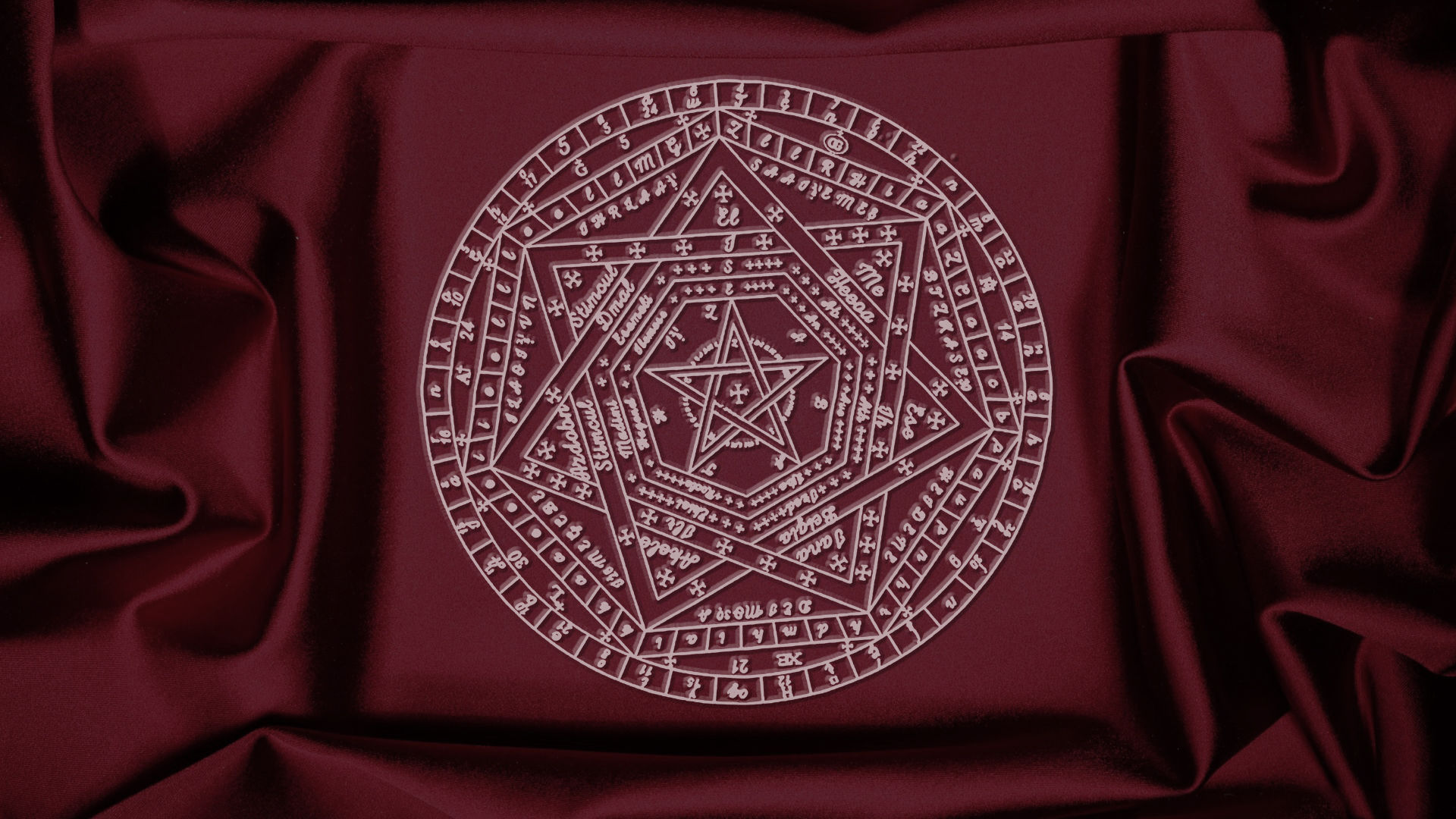


Magie du 16ème siècle
L'humanisme de la Renaissance (XVe et XVIe siècles) a vu une résurgence de l'hermétisme et des variétés néo-platoniciennes de magie cérémonielle. La géomancie a été classée comme l'un des sept "arts interdits", avec l'hydromancie, l'aéromancie, la pyromancie, la chiromancie (chiromancie), la spatulamancie (scapulimancie) et la nécromancie.
54 Forms of Divination:
Aeromancy
Alectryomancy
Aleuromancy
Aspidomancy
Astragalomancy
Axinomancy
Botanomancy
Carromancy
Catoptromancy
Cattabomancy
Causimomnancy
Chartomancy
Chiromancy
Cleidomancy
Coscinomancy
Critomancy
Cromniomancy
Cystallomancy
Demonomancy
Eromancy
Floromancy
Gyromancy
Hydromancy
Lampadomancy
Lithomancy
Livanomancy
Macharomancy
Myomancy
Necromancy
Onomancy
Oneiromancy
Onychomancy
Oomancy
Ophiomancy
Oneiromancy
Peggomancy
Phyllorhodomancy
Podomancy
Psychomancy
Pyromancy
Rabdomancy
Scapulimancy
Sciomancy
Sideromancy
Spatalomancy
Stareomancy
Sternomancy
Sycomancy
Tasseomancy
Theomancy
Theriomancy
Tuphramancy
Tyromancy
Xylomancy
Géomancie
L'art de la géomancie était l'une des formes de magie les plus populaires que les gens pratiquaient pendant la période de la Renaissance. La géomancie était une forme de divination où une personne jetait du sable, de la pierre ou de la terre sur le sol et lisait les formes. Les figures géomantiques leur diraient alors "n'importe quoi" sur la base des cartes de géomancie utilisées pour lire à partir de la forme.


Scrying
Scrying is the practice of looking into a suitable medium in the hope of detecting significant messages or visions. The objective might be personal guidance, prophecy, revelation, or inspiration, but down the ages, scrying in various forms also has been a means of divination or fortune-telling. It remains popular in occult circles, discussed in many media, both modern and centuries old.


Scrying
Également connue sous divers noms tels que "voir" ou "peeping", est la pratique consistant à regarder dans un support approprié dans l'espoir de détecter des messages ou des visions significatifs. L'objectif peut être l'orientation personnelle, la prophétie, la révélation ou l'inspiration, mais à travers les âges, la divination sous diverses formes a également été un moyen de divination ou de divination. Il reste populaire dans les cercles occultes, discuté dans de nombreux médias, à la fois modernes et séculaires.
Une classe de méthodes de scrying implique une transe auto-induite, avec ou sans l'aide d'un support tel qu'une boule de cristal ou, même via une technologie moderne telle qu'un smartphone entre autres. Certains disent que la sensation ressemble à une drogue, d'autres que diverses drogues peuvent potentialiser l'expérience ; d'autres excluent catégoriquement tout lien avec la consommation de drogue, affirmant que cela invalide toutes les images observées.
De nombreux praticiens disent que le médium de scrutation sert initialement à concentrer l'attention, en éliminant les pensées indésirables de l'esprit de la même manière que la répétition d'un mantra, la concentration sur un mandala, induisant la réponse de relaxation, ou éventuellement par l'hypnose. Une fois cette étape franchie, le scryer peut entamer une association libre avec les images perçues. La technique consistant à rechercher délibérément et à déclarer à haute voix ces images initiales, aussi insignifiantes ou non pertinentes qu'elles puissent paraître à l'esprit conscient, tente d'approfondir l'état de transe. Dans cet état, certains voyants entendent leurs propres voix dissociées affirmer ce qu'ils voient, dans une boucle de rétroaction mentale.
Les praticiens appliquent le processus jusqu'à ce qu'ils atteignent un état de perception satisfaisant dans lequel des images visuelles riches et des histoires dramatiques semblent être projetées dans le médium lui-même, ou dans l'œil de l'esprit du voyeur. Ils affirment que la technique leur permet de voir des événements ou des images pertinents dans le support choisi.
Nostradamus pratiquait la scrutation ; il regardait dans un bol d'eau ou un "miroir noir" pour voir l'avenir pendant qu'il était en transe.
Oniromancie
(du grec όνειροϛ oneiros, rêve, et μαντεία manteia, prophétie) est une forme de divination basée sur les rêves, et utilise également les rêves pour prédire l'avenir. Les médicaments Oneirogen peuvent également être utilisés pour produire ou améliorer des états de conscience oniriques. Parfois, le rêveur a l'impression d'être transporté dans un autre temps ou lieu, et cela est présenté comme la preuve qu'il fournit en fait des informations divines à son retour.
Un exemple était par exemple la Pythie, qui était sous l'influence du gaz vulcanique.
Liste des onirogènes possibles
Amanita muscaria (contient du muscimol)
Artemisia douglasiana ou armoise de Californie, sagewort ou plante de rêve de Douglas, est une espèce d'herbe aromatique de l'ouest de l'Amérique du Nord de la famille des tournesols qui peut être utilisée comme parfum, thé ou fumée pour déclencher des rêves vifs et lucides. [citation nécessaire]
Artemisia vulgaire
La racine d'asperge rouge sauvage peut favoriser les rêves qui impliquent de voler.
Atropa belladonna (contient de l'atropine, de l'hyoscyamine et de la scopolamine)
Atropine (via le blocage des récepteurs de l'acétylcholine)
Benzatropine
Calea ternifolia
Calea zacatechichi a été traditionnellement utilisée en Amérique centrale comme moyen cru de potentialiser les rêves lucides et d'effectuer la divination des rêves. Il peut favoriser des rêves vifs pour les sens, la vue, l'odorat, l'ouïe, le toucher et le goût. Peut être consommé en infusion ou fumé.
Datura (contient de l'atropine, de l'hyoscyamine et de la scopolamine)
La diméthyltryptamine (DMT) peut déclencher des états de rêve chargés spirituellement, intensément vifs et surréalistes.
Entada rheedii ("haricot de rêve africain")
Galanthus (genre) - On pense qu'un alcaloïde de la plante augmente la concentration d'acétylcholine - un neurotransmetteur qui joue un rôle très actif dans le rêve
Hyoscyamine (jusquiame)
Armoise, voir Artemisia douglasiana
La noix de muscade en quantités couramment utilisées, la myristicine et l'élémicine, peut augmenter la vivacité des rêves.
Les fleurs séchées de nénuphar peuvent être fumées, ou les rhizomes mangés, pour favoriser des rêves éclatants.
De nombreux opioïdes peuvent produire un état euphorique semblable à un rêve avec microsommeil, connu familièrement sous le nom de « hochement de tête ».
Peganum harmala (contient de l'harmaline)
Salvia divinorum et autres agonistes des récepteurs Kappa.
Scopolamine
Silene undulata ("racine de rêve africaine") est utilisée par le peuple Xhosa d'Afrique du Sud pour induire des rêves lucides.[7]
Champignon Magique et Truffes.
Step two:
Place and light a candle on either side of the mirror. You can use either candles that are the same colors or are different colors, but choose colors that are not distracting; the colors should be somewhat dull. The colors can also be suitable for the atmosphere that is created for the scrying ritual.
If you are unsure, then just put a tea light candle in place of candles on either side.
What you should really focus on is making sure that the candles or tea light candles are put in the right place. You want them to the side and a little in front of the mirror so that the mirror is fully illuminated, but the candles are not reflected in the mirror.
OPTIONAL STEP:
If you would like to, burn some incense in front of the mirror, preferably a slow burning resin on a piece of coal, in a way so that the smoke can help you see things in the mirror more easily. (Use incense as needed throughout the ritual.)
Step three:
Meditate until you reach and maintain a deeply relaxed state.
You could be meditating for a while, between three to 20 minutes, depending on how long it will take for you to be able to focus for three to five minutes straight without any random thoughts interrupting you.
If you cannot easily reach a deeply relaxed state, stop at this step and fully practice meditation for a while until you can. Meditation is really key for scrying, so you will really need to develop proper meditation skills if you want to proceed further in the scrying procedure.
Now, you are prepared to continue to the actual ritual of scrying:
Step one:
Look at your black mirror with a “soft focus”.
“Soft focus” refers to focusing your vision just a little before or a little behind the mirror. Basically, your vision of the mirror should look like it is a slightly out of focus picture. The easiest way to “soft focus” is to focus your vision so that you can see the whole mirror, but the pupils of your eyes are focused on a place about an inch or two in front of the mirror.
Step two:
Look at your mirror with a “soft focus” for several minutes (you may blink regularly).
Step three:
As you stare at the mirror, the mirror will seem to you like it is kind of “fogging” over, which means it will either look a little hazy or cloudy and a little gray in color. When the mirror is beginning to look like this to you, this means you are beginning your scrying experience.
Until this occurs to you, you are not going to get very far into the scrying process. If you succeed in performing this step, you will truly advance in the scrying process. This is why you need to have had practice seeing with a “soft focus” before even beginning the actual scrying ritual.
Step four:
Once the mirror completely fogs over in your vision, keep looking at the mirror with a “soft focus” and keep a clear and open mind. You could begin to view visions or to think various thoughts in your mind. Whatever happens, just let yourself experience the visions or thoughts; let them fully develop in your mind for as long as you need them to.
These visions and thoughts that are materializing in your mind are the results that you are looking for when scrying with a black mirror. On your first try, you may not get anything of real substance, but if you go through this ritual several times, your mind could piece together something meaningful and helpful for you. However, you need to have and maintain a strong connection to your unconsciousness if you wish to make actual progress with scrying with a black mirror.

Nostradamus practiced scrying; he would stare into a bowl of water while he was in trance probably induced by a Belladonna potion.

Edward Kelley and John Dee used a "shewstone", which was a piece of polished obsidian as a makeshift mirror.
Hydromancie
L'hydromancie, une forme de divination utilisant l'eau, est généralement utilisée avec la divination. L'eau est utilisée comme moyen de scrutation pour permettre au praticien d'y voir des images illusoires. L'hydromancie est originaire de Babylone et était populaire à l'époque byzantine alors que dans l'Europe médiévale, elle était associée à la sorcellerie.

Hydromancie
L'hydromancie, une forme de divination utilisant l'eau, est généralement utilisée avec la divination. L'eau est utilisée comme moyen de scrutation pour permettre au praticien d'y voir des images illusoires. L'hydromancie est originaire de Babylone et était populaire à l'époque byzantine alors que dans l'Europe médiévale, elle était associée à la sorcellerie.
Pyromancie
La pyromancie est l'art de la divination qui consistait en des signes et des motifs de flammes ou de fumée. Il existe de nombreuses variantes de pyromancie en fonction du matériau jeté dans un feu et on pense qu'il est utilisé pour les sacrifices aux dieux et que la divinité est présente dans les flammes avec des prêtres interprétant les présages transmis.

Chiromancie
La chiromancie est une forme de divination basée sur la lecture des paumes et basée sur les intuitions et le symbolisme avec certains symboles liés à l'astrologie. Une ligne de la main d'une personne qui ressemble à un carré est considérée comme un mauvais présage alors qu'un triangle serait un bon présage. Cette idée vient de l'aspect trigone et carré dans les aspects astrologiques.
Xylomancy
An unusual and oft-overlooked means of Divination, Xylomancy is a hard to understand phenomenon, midway between the phenomenon of true seers, and the natural phenomenon of ambient magic. Twigs, collected from highly magical areas, can often be remarkably in tune with the magic and thus likely fate of that area, as well as being well-attuned to pick up the ambient magic and thus indicators of environment elsewhere - it is these kind of magically imbued twigs that often become dowsing rods or magic wands.
Xylomancy is a particular phenomenon found when a Seer, or someone with some training in Divination, uses a number such twigs as prophetic conduits.
Dination with Ogham & Rune sticks and Druid sticks are some of the forms of Xylomancy still used untill this day. While some Seers are pure prophets, speaking prophetic verse when so pushed, others require specific conduits - smoke or stars or crystal orbs, tea leaves, the organs of a sacrificial animal… or xylomantic twigs. The way in which they fall can, in those with innate Seer ability, trigger prophetic visions or even full prophecy, while in those with merely training, the patterns they fall in can have arithmantic meaning.

Of course, one must be careful to use twigs from areas with high levels of ambient magic, as anything less is utterly useless.

Catoptromancy
Catoptromancy (Gk. κάτοπτρον, katoptron, "mirror," and μαντεία, manteia, "divination"), also known as captromancy or enoptromancy, is divination using a mirror.
Pausanias, an ancient Greek traveler, described as follows:
Before the Temple of Ceres at Patras, there was a fountain, separated from the temple by a wall, and there was an oracle, very truthful, not for all events, but for the sick only. The sick person let down a mirror, suspended by a thread till its base touched the surface of the water, having first prayed to the goddess and offered incense. Then; looking into the mirror, he saw the presage of death or recovery, according as the face appeared fresh and healthy, or of a ghastly aspect.
In Ancient Rome, the priests who used catoptromancy were called specularii.

Russian folk catoptromancy by Karl Briullov, 1836

Demonomancy
Demonomancy is the art of divination by summoning Demons.
They may be nonhuman, separable souls, or discarnate spirits which have never inhabited a body. A sharp distinction is often drawn between these two classes, notably by the Melanesians, several African groups, and others. The Islamic jinn, for example, are not reducible to modified human souls. At the same time these classes are frequently conceived as producing identical results, e.g. diseases.
Etymology
From Greek daimon, divine power
Methods
The divination occurs through the oracles made by the Demons, or the answers they give to the inquirers. However, this form of divination is thought to be not very reliable because Demons are reputedly vain and unreliable. Each Demon is supposed to obey only if the seer uses the proper ritual.
Pazuzu,
Domestic Evil Wind Demon
Classification of demons
Demons are generally classified as spirits which are believed to enter into relations with the human race. As such the term includes:
-
angels in the Christian tradition that fell from grace,
-
malevolent genii or familiars,
-
such as receive a cult (e.g., ancestor worship),
-
ghosts or other malevolent revenants.
Excluded are souls conceived as inhabiting another world. Yet just as gods are not necessarily spiritual, demons may also be regarded as corporeal; vampires for example are sometimes described as human heads with appended entrails, which issue from the tomb to attack the living during the night watches.
The so-called Spectre Huntsman of the Malay Peninsula is said to be a man who scours the firmament with his dogs, vainly seeking for what he could not find on Earth: a buck mouse-deer pregnant with male offspring; but he seems to be a living man; there is no statement that he ever died, nor yet that he is a spirit.
The incubi and succubi of the Middle Ages are sometimes regarded as spiritual beings; but they were held to give proof of their bodily existence, such as offspring (though often deformed). Belief in demons goes back many millennia. The Zoroastrian faith teaches that there are 3,333 Demons, some with specific dark responsibilities such as war, starvation, sickness, etc.
The early Enochian tradition bases its understanding of the origin of demons on the story of the fallen Watchers led by Azazel.
In Muslim divination they speak of The Ghul and the Si'lah, both shapeshifters and Ifrit and the Marid. The Ifrit is also related to the ghosts of the dead, seeking revenge, unlike the Marid. On the other hand, the Marid is related to those assistants of truth sayers, striving to heaven to access information from the angels, while the Ifrit does not.
Necromancy also calls up demons, a list with their names and sigils can be found in the Necronomicon
Onomancy
Onomancy (or nomancy) is divination based on a subject's name. Onomancy was popular in Europe during the Late Middle Ages but is said to have originated with the Pythagoreans. Several methods of analyzing a name are possible, some of which are based on arithmancy or gematria.
An early example of onomancy is found in the Secretum Secretorum. The system given there involves adding up the numerical values of the letters in the names of two antagonists, dividing the total for each person by 9, and comparing the remainders with a table which predicts the victor.
In China, Taiwan, and Japan, onomancy is known as 姓名判断 (Chinese: xingming panduan; Japanese: seimei handan). It can take several forms, but the most popular is based on the character strokes in the subject's written name, and the result number will be modulo 81, the remainders 0, 1、3、5、6、7、8、11、13、15、16、17、18、21、23、24、25、29、31、32、33、35、37、38、39、41、45、47、48、52、57、58、61、63、65、67、68 are “lucky” numbers.

Two charts from Kitab Sirr al-asrar,
an Arabic copy of
the Secretum Secretorum (1264)
Haplological for onomancy:
Onomancy means ‘divination by names’, and, if surviving manuscript numbers are any indication, the most common form of divination in the later Middle Ages. Divination is an ancient and cross-cultural phenomenon. Benedek Láng provides a succinct definition: it is ‘the procedure of foretelling the future and discovering hidden knowledge through the interpretation of signs’. There are many forms present in medieval sources, which fall into two categories – ‘active’, or set up (such as dice throwing); and ‘passive’, or spontaneous (such as omens and portents). Onomancy falls into the first category, along with other types of divination such as geomancy (drawing dots), chiromancy (palm-reading) and bibliomancy (randomly opening books, usually the Bible)

the Sphere of Life and Death
or Sphere of Pythagoras
The most commonly-occurring variety in medieval manuscripts, the Sphere of Life and Death or Sphere of Pythagoras.
The Sphere is most often used to predict whether a sick person will live or die, but is also used for any question about an individual requiring a yes/no answer. The six-line verse at the bottom of the page instructs the operator to take the name of the sick person and convert the letters of their name into numerical equivalents (which are found in the two outer rims of the diagram). You add these up into a total. Add the number of the day of the moon on which they first fell sick (a number between 1-30), and the number of the planetary weekday (each day has a corresponding number, usually located in or next to the diagram). These three numbers are added into a grand total and divided by 30. If the remainder is in the top hemisphere, the person will live, if in the bottom, they will die. The three columns of numbers indicate whether recovery or death will be quick, medium or slow.

Physician’s folding almanac containing a Sphere (England c. 1375)
The Sphere is first attested in a Greek papyrus made in the fourth century CE, but it probably has much older roots. It was translated, and the earliest surviving example in Latin dates from around 805 CE. However, there was an inherent problem with translation into Latin. Every Greek letter has a corresponding number, but not every Latin letter does. This led to confusion as medieval Latin translators and copyists tried to find the ‘correct’ original and ascribed numbers to letters without any rationale. The result was that multiple versions of the Sphere survive with different number-letter correlations and different remainders in the centre. Another problem was posed by non-Latin letters like K and W. Most Spheres leave these out, but the copyist of a physician’s almanac, now London British Library MS Harley 5311, made in 1406, added:
Note that if there is a double letter taken from another language it should not be two numbers but one, so for William first V and then I should be used and so too of the rest.
So, using a Sphere was not an exact science, and there was plenty of space for ambiguity.
The Sphere was not the only onomantic method circulating in medieval manuscripts. Here is an experiment found in at least four manuscripts of English provenance produced in the fourteenth and fifteenth centuries:
"If you want to know who will die first, a husband or wife, calculate their names, and find out the numbers of the letters and divide by nine. If the number is even the wife will lead the husband to the grave. If odd the husband will be buried by the wife."
It is not difficult to imagine why such knowledge might have been desirable to either party in a marriage!
Yet more onomantic texts survive from the later Middle Ages, such as the Victorious and Vanquished, which pits two values against one another. This was used for working out which of two generals or parties might succeed in a battle or duel. But by far the most commonly-surviving onomantic method is the Sphere.

Aéromancie
La divination de l'aéromancie consistait à jeter du sable, de la terre ou des graines dans l'air et à étudier et interpréter les motifs du nuage de poussière ou la sédimentation des graines.[81] Cela inclut également la divination provenant du tonnerre, des comètes, des étoiles filantes et de la forme des nuages.
Scapulimancie
La scapulimancie était une forme de divination utilisant l'omoplate d'un animal. L'omoplate serait cassée et en fonction de la façon dont elle a été cassée, elle pourrait être utilisée pour lire l'avenir. Il était généralement cassé en le chauffant avec des charbons ardents jusqu'à ce qu'il se brise.


Druidic Spoon Divination
The Ancient Druids (200 BC - AD 50) had tools used for predicting the future with one example being the divination spoons, a small set of golden leaf shaped items which were concave with a small hole upon one of the leaflets.
Blood would be blown into this hole using a small tube and the breath of a Druid so that its final patterns could be used to predict the outcome of certain events. It consisted of placing the two halves of the spoon together and the via a small hole in one side of the spoon, blowing in either blood or ground up bone with a straw. Then upon opening the spoons and inspecting the pattern made and its location within four quandrants the Druid would then interpret the divination.
This is important because these interpretations were completely subjective (e.g. if a Druid wanted to go to war, many people could potentially die dependent upon how they read these natural signs as prophecies). Manipulation of these results and their prophetic message would be undetectable by common people as only the Druids knew how to read the signs which they were looking for. This opens the door for corruption and/or the tampering of results and their message. The Druids remained so powerful that even Celtic monarchs revered and respected their authority.
Despite this enormous influence, apart from divination spoons, definitive and conclusive evidence of Druid prophetic tools have never been found.
Carromancy
(from Greek κηρός, 'wax', and μαντεία, 'divination'), otherwise known as ceromancy, is a form of divination involving wax. One of the most common methods of carromancy is to heat wax until molten, then to pour it directly into cold water. The shapes and movements of the wax as it cools and solidifies can then allegedly be read to forecast auguries of the future. Another method more commonly practiced in the contemporary era is studying the burning of an ordinary candle. The movements and erratic actions of the flame are then said to predict the future.
Carromancy also has roots in ancient Celtic and perhaps later in Ancient Roman times.
According to scraps of knowledge salvaged from around the period CE 500, it appears that the candle burned during a druid's vigil was poured into a bowl and then into a clear pool of cold water. The auguries for the future could then be read.

Oinomancy
Oinomancy (or oenomancy or œnomancy) is a form of divination conducted by examining patterns in wine. An ancient technique, oinomancy was performed by a priestess known as a Bacchante, and protected by Bacchus, the Roman god of wine. Oinomancy is still practiced today, but is rare in the United States.
Oinomancy could be performed in a number of ways:
-
Wine is spilled on cloth or paper, and the resulting stains are studied.
-
Cloth or paper is soaked or boiled in wine, and the resulting appearance of the material is studied.
-
The appearance of wine being poured as an offering during a libation is studied.
-
The sediment in the bottom of a glass or bottle of wine is studied.
-
The physical features (color, taste, etc.) of wine are studied.

Bacchante by
William Adolphe Bouguereau

Alectryomancy
Alectryomancy (also called alectoromancy or alectromancy; derivation comes from the Greek words ἀλεκτρυών alectryon and μαντεία manteia, which mean rooster and divination, respectively) is a form of divination in which the diviner observes a bird, several birds, or most preferably a white rooster or cockerel pecking at grain (such as wheat) that the diviner has scattered on the ground. It was the responsibility of the pullularius to feed and keep the birds used. The observer may place grain in the shape of letters and thus discern a divinatory revelation by noting which letters the birds peck at, or the diviner may just interpret the pattern left by the birds' pecking in randomly scattered grain.
In another version, the observer tethers the bird in the center of a circle, around the perimeter of which is marked the alphabet, with a piece of grain at each letter. For each grain the bird pecks, the observer writes down the letter which that grain represents. The observer also replaces each grain as the bird eats it, so that letters may be repeated. The sequence of letters recorded will presumably contain a message.
Christmastide Divination by Konstantin Makovsky showing a Russian folk alectryomancy during Eastern Orthodox Christmastide to foretell a marriage in the near future.
This form of divination is related to Ouija, by the random selection of letters; to gyromancy, by the random selection of letters from a circle around the diviner himself; and to orniscopy, divination by the movements of birds.
Alectryomancy is also sacrificing a sacred rooster. The use of the sacred rooster through alectryomancy may be further understood within that religious character and likewise defined as the cockfight or cockfighting with the intent of communication between the gods and man.
History
Roosters were commonly used for predictions in different parts of the world, and over the ages different methods were used. The most common and popular form of this divination based on the observation of a rooster eating corn scattered on letters. This practice was used when the sun or the moon was in Aries or Leo. A circle of letters (originally twenty-four in number, since j, v are the same as i, u) was traced on the ground and laid out with some sort of grain placed on each letter. Next a rooster, usually a white one, was let pick at the grains, thus selecting letters to create a divinatory message or sign. The chosen letters could be either read in order of selection, or rearranged to make an anagram. Sometimes readers got 2 or 3 letters and interpreted them. Additional grains replaced those taken by the rooster. We do not know exactly how long ago this form of mantic arts had been practiced, but can date it back to at least 300 A.D. with evidence given by Iamlicus, a Syrian Neoplatonist philosopher from Arabian origin. According to legend, the magician Lamblicus used this art to discover the person who should succeed Valens Caesar in the empire, but the bird picking up four of the grains, those which lay on the letters "T h e o," left it uncertain whether Theodosius, Theodotus, Theodorus, or Theodectes, was the person designated. Valens, however, learning what had been done, put to death several individuals whose names unhappily began with those letters.
Africa
In Africa, a black hen or a gamecock is used, which within such a religious practice and belief to foresee, to be inspired by a god, may be accurately referred to as a sacred cock or sacred vessel. An African diviner sprinkles grain on the ground and when the bird has finished eating, the seer interprets the designs or patterns left on the ground.
Another method of alectryomancy, supposedly used less often, was based on reciting letters of the alphabet noting those at which a cock crows. Letters were recorded in sequence and then these letters were interpreted as the answer to the question chosen by seers.
Roman alectryomancy
Alectryomancy was part of a deeply entrenched tradition among the Romans, where the chicken is used for all sorts of divination with the belief that the animal is a soothsayer. For this reason, the chicken figured prominently in public policy since no major decision was made without using the animal in divination rites. Aside from alectryomancy, the chicken was also used to divine the future with diviners trained to read meanings in the bird's organs, feather, skin, flesh, and bone.
The Roman chicken divination rituals were complex and conducted with an extraordinary level of organization unparalleled among the ancient civilizations that shared the same practice. One of the earliest forms was developed by the Etruscans, who established an elaborate ritual of alectryomancy using a hen to find answers for life's most pressing problems. The process involved a circle, which was divided into twenty parts to represent the Etruscan alphabet and each sector was sprinkled with corn. The bird is placed at the middle and the sequence of its pecking was recorded. Specifically, alectryomancy was used in ancient Rome to identify thieves.
A rare, obsolete meaning of alectryomancy is "a divination by a cock-stone". A cock-stone or alectoria was "a christall coloured stone (as big as a beane) found in the gyzerne, or maw of some cockes" (Cotgrave). These stones, purportedly found in a rooster's crop, were known to the Romans (in Latin they were called alectoria gemma, literally "cock's gem") and were imputed with magical powers. Apparently, they were used for some sort of lithomantic divination, though the details of this use are not to be found.
Oomancy
Oomancy (sometimes called ovomancy, ooscopy, oomancia, oomantia, ooscopia, or ovamancy) refers to divination by eggs. There are several methods to how this can be done, but an example would be the oracular reading (i.e., scrying) of the shapes that a separated egg white forms when dropped into hot water. This method greatly resembles molten lead divination, which ascribe meaning to the shapes and forms into which hot lead solidifies.
Origin
The word oomancy is derived from two Greek words, oon (an egg) and Manteia (divination), which literally translates into egg divination. Oomancy was common form of divination practiced in ancient Greece and Rome, where it was believed that one could tell the future by interpreting the shapes formed when the separated whites from an egg was dropped into hot water.
For example: If the egg white resembled the shape of a bell, it would mean a wedding would be taking place soon. If the egg white resembled a snake, then it was considered a warning of danger.
History
Although oomancy was thought to have originated in Greece, there is belief this practice was also used by ancient druids in Scotland as well.
Egg divination was often used to gain knowledge about children still in the womb, such as the gender, health, and due date of the unborn baby. In practice, they would rub an uncooked chicken egg on the pregnant mother's belly, then crack it into a saucer. If the broken egg contained one yolk, then the mother would give birth to one child. If the egg contained 2 yolks, 3 yolks, or more, this would indicate the mother would give birth to twin or triplets or so on. It was also believed that if the yolk contained spots of blood, it was a bad sign indicating a miscarriage or complications during birth. Another common method of oomancy in regards to the unborn child is to incubate a chicken egg between the pregnant woman's breasts. It was believed that when the chick hatched, its gender would reveal the gender of the mother's unborn child. There was also a form of oomancy that didn't involve cracking an egg open, but rather hard boiling it instead. On one end of the egg was written the name of a god or goddess, and on the other end was written a goal the person wished to achieve. The hard boiled egg was then allowed to roll down a slope, and interpreted by which end was facing upward and what direction the egg was pointing.
Oomancy was a popular divination method used in New England in the late 17th century.
Along with other young girls of Salem Village, Elizabeth Parris and Abigail Williams are known to have to played at reading omens by means of an egg and a mirror (or "Venus glass"), an apparently similar system of egg divination. It was reported by Reverend John Hale that these girls used eggs in a glass to learn the profession of their future husbands.
The Norse tradition of oomancy was to pierce the egg and blow the egg white out into a glass of water where it was left for a day. Then the diviner would use the egg glass to scry for answers to the question.
In 1806, Mary Bateman, also known as the "Yorkshire Witch," created a hoax known as The Prophet Hen of Leeds, in which eggs laid by a hen were purported have written on them 'Christ is coming' - a message believed to precede the end times. Three of these eggs were displayed by Bateman, but it was later found that she had written on the eggs using acid and reinserted them into the hen's oviduct.


Oomancy and the evil eye
Often in history the egg has been associated with the evil eye. Egg divination would be performed on a client believed to have received the evil eye. When performing this ritual, the egg is passed over the person's body or rolled upon the skin, then it is placed beneath the clients bed, upon the mantle, or on the altar. After a day, the egg is cracked into a glass or bowl half full of water and is then interpreted to see if the client has been given the evil eye.

Modern uses and occult practices
Oomancy has become very popular in modern occult and new age traditions. Traditions such as Wicca, modern paganism, and modern witchcraft not only use eggs for divination but also cleansing and removal of negative energies. It is a cultural tradition among latin Americans to use Oomancy to rid themself of the evil eye and brujeria done on them. This practice in latin american countries dates back to the native shamans and african brought over to the Americas.
One way this can be done is to roll the egg all over a person's body so it can absorb the negative energy within the person. Then this egg is cracked open into a bowl of water where it can be interpreted as to whether or not the negativity has left the body. A modern-day variation of the hard boiled egg divination is to draw symbols on different spots of the egg shell that each indicate a different answer to the question being asked. After the egg is rolled down the slope, whatever symbol is facing up is considered the answer.
In parts of South and Southeast Asia, eggs are thrown onto the ground, and the shapes made upon impact are interpreted.
In Guatemala, eggs are used to diagnose illnesses by passing several eggs over the patient and placing them in water to be interpreted. This same technique has been used in Hoodoo traditions to treat the sick and injured.
Scapulimancie
La scapulimancie était une forme de divination utilisant l'omoplate d'un animal. L'omoplate serait cassée et en fonction de la façon dont elle a été cassée, elle pourrait être utilisée pour lire l'avenir. Il était généralement cassé en le chauffant avec des charbons ardents jusqu'à ce qu'il se brise.


Cystallomancy
The Apparatus of Ceremonial Cystallomancy is a white-magic divination tool that you gaze into, similar to the Mirror of Solomon. The crystal is mounted in a frame, made of polished ebony, ivory, or boxwood. The engraved candlesticks must be brass. From The Book of Black Magic and Pacts, A.E. Waite, 1910.

Chrystallomancy
Divination by looking into a reflective or transparent object such as a crystal or various shapes of glass. Although crystal balls are now popular for this, in the past a piece of beryl, in reddish or pale green shades, was often used.

Terramancy
Description
Terramancy is a form of magic that manipulates the earth - not in the sense of natural magic that utilizes flora - but directly with the earth: rock, metal, and mineral. In modern days, it goes by the name telekinesis.
Terramancers
Terramancers are a unique type of spellcasters. Their power to cast spells is not drawn from the Spirit as most spells are. Instead, the power is drawn directly from the earth. Another unique aspect of Terramancy is that the skill cannot be learned through any amount of study or obtained through the use of any magical devices. It is an inherent ability present in a rare few. The difference in power of Terramancers is the degree in which they have learned to harness the power.
Terramancy is a magic of passion. The manifestations of the power are directly proportional to the passion of the caster. Intense love, hate, sadness, anger, and joy fuels the desired effects of a Terramancer. The passion cannot be feigned. The most powerful spells are the result of powerful emotion.
Training
Training is always one on one from a skilled Terramancer mentor. It takes several years to hone a talent strong enough to have any real effect at will. Even when training is complete after several years of tutelage, the power is still relatively raw and difficult to utilize. To further enhance the effects, most Terramancers utilize a Focus.
Foci
In order to further concentrate their power, most Terramancers use a Focus. A Focus is a magically enhanced item intended to enhance the desired manifestations of the Terramancer. A Focus is always made of an earthly material, such as a pure metal or stone. Obsidian rings are a common Focus. The mass off the Focus is directly proportional to the effectiveness. There are diminishing returns on size, yet some Terramancers utilize massive Foci to gain the maximum effectiveness from their efforts.

Scapulimancie
La scapulimancie était une forme de divination utilisant l'omoplate d'un animal. L'omoplate serait cassée et en fonction de la façon dont elle a été cassée, elle pourrait être utilisée pour lire l'avenir. Il était généralement cassé en le chauffant avec des charbons ardents jusqu'à ce qu'il se brise.


Portrait of Queen Elizabeth I (1533-1603) in Ceremonial Costume holding a sieve - Federico Zuccari


Oneiromancy
(from the Greek όνειροϛ oneiros, dream, and μαντεία manteia, prophecy) is a form of divination based upon dreams, and also uses dreams to predict the future. Oneirogen drugs may also be used to produce or enhance dream-like states of consciousness. Occasionally, the dreamer feels as if they are transported to another time or place, and this is offered as evidence they are in fact providing divine information upon their return.
An example was for instance the Pythia, who was under the influence of vulcanic gas.
List of possible oneirogens:
-
Amanita muscaria (contains muscimol)
-
Artemisia douglasiana or California mugwort, Douglas's sagewort or dream plant, is a western North American species of aromatic herb in the sunflower family that can be used as a scent, tea, or smoke to trigger vivid and lucid dreams.[citation needed]
-
Artemisia vulgaris
-
Wild red asparagus root may promote dreams that involve flying.
-
Atropa belladonna (contains atropine, hyoscyamine, and scopolamine)
-
Atropine (via blockade of acetylcholine receptors)
-
Benzatropine
-
Calea ternifolia
-
Calea zacatechichi has been traditionally used in Central America as a believed way to potentiate lucid dreams and perform dream divination. It can promote dreams vivid to the senses, sight, scent, hearing, touch, and taste. May be taken as a tea or smoked.
-
Datura (contains atropine, hyoscyamine, and scopolamine)
-
Dimethyltryptamine (DMT) can trigger intensely vivid and surreal spiritually charged dream states.
-
Entada rheedii ("African dream bean")
-
Galanthus (genus) – An alkaloid in the plant is believed to increase the concentration of acetylcholine – a neurotransmitter that plays a very active role in dreaming
-
Hyoscyamine (Henbane)
-
Mugwort, see Artemisia douglasiana
-
Nutmeg in commonly used amounts myristicin and elemicin, can increase vividness of dreams.
-
Water lily dried flowers may be smoked, or the rhizomes eaten, to promote vivid dreams.
-
Many opioids may produce a euphoric dream-like state with microsleep, known colloquially as "nodding".
-
Peganum harmala (contains harmaline)
-
Salvia divinorum and other Kappa receptor agonists.
-
Scopolamine
-
Silene undulata ("African dream root") is used by the Xhosa people of South Africa to induce lucid dreams.
-
LSD, Mescaline, Peyote, Magic Mushrooms and Truffels...


Scapulimancie
La scapulimancie était une forme de divination utilisant l'omoplate d'un animal. L'omoplate serait cassée et en fonction de la façon dont elle a été cassée, elle pourrait être utilisée pour lire l'avenir. Il était généralement cassé en le chauffant avec des charbons ardents jusqu'à ce qu'il se brise.
Edward Kelly and Dr. John Dee perform necromancy {illustration ca.1890}

Nécromancie
Les praticiens de la nécromancie ou de la magie démoniaque à la fin du Moyen Âge appartenaient généralement à l'élite éduquée, car le contenu de la plupart des grimoires était écrit en latin. La magie démoniaque était généralement pratiquée en groupes entourant un chef spirituel en possession de livres de nécromancie. Un de ces cas en 1444, l'inquisiteur Gaspare Sighicelli a pris des mesures contre un groupe actif à Bologne. Marco Mattei de Gesso et le frère Jacopo de Viterbe ont avoué avoir participé à des pratiques magiques.

Pages from The Richard Rawlinson Necromantic Manuscript
(unknown author/artist, 15th century)
The Ouija Board
The ouija, also known as a spirit board or talking board, Is the most wellknown necromantic tool. It is a flat board marked with the letters of the alphabet, the numbers 0–9, the words "yes", "no", occasionally "hello" and "goodbye", along with various symbols and graphics. It uses a planchette (small heart-shaped piece of wood or plastic) as a movable indicator to spell out messages during a séance. Participants place their fingers on the planchette, and it is moved about the board to spell out words. "Ouija" is a trademark of Hasbro, but is often used generically to refer to any talking board.
Spiritualists in the United States believed that the dead were able to contact the living and reportedly used a talking board very similar to a modern Ouija board at their camps in the U.S. state of Ohio in 1886 to ostensibly enable faster communication with spirits. Following its commercial introduction by businessman Elijah Bond on 1 July 1890, the Ouija board was regarded as an innocent parlor game unrelated to the occult until American spiritualist Pearl Curran popularized its use as a divining tool during World War I.
Paranormal and supernatural beliefs associated with Ouija have been criticized by the scientific community and are characterized as pseudoscience. The action of the board can be most easily explained by unconscious movements of those controlling the pointer, a psychophysiological phenomenon known as the ideomotor effect.
Mainstream Christian denominations, including Catholicism, have "warned against using Ouija boards", holding that they can lead to demonic possession. Occultists, on the other hand, are divided on the issue, with some saying that it can be a tool for positive transformation; others reiterated the warnings of many Christians and caution "inexperienced users" against it.

Quija board by Myrddin © 2022
History
Precursors
One of the first mentions of the automatic writing method used in the ouija board is found in China around 1100 AD, in historical documents of the Song Dynasty. The method was known as fuji "planchette writing". The use of planchette writing as an ostensible means of necromancy and communion with the spirit-world continued, and, albeit under special rituals and supervisions, was a central practice of the Quanzhen School, until it was forbidden by the Qing Dynasty.

Early British Planchette, 1850s–60s.
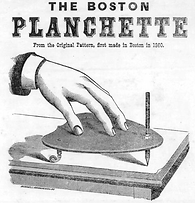
1860 ad for Boston Planchette

Ouija board by William Fudd, 1897
Talking boards
As a part of the spiritualist movement, mediums began to employ various means for communication with the dead. Following the American Civil War in the United States, mediums did significant business in allegedly allowing survivors to contact lost relatives. The ouija itself was created and named in Baltimore, Maryland, in 1890, but the use of talking boards was so common by 1886 that news reported the phenomenon taking over the spiritualists' camps in Ohio.
Since early in the Ouija board's history, it has been criticized by several Christian denominations. The Catholic Church in the Catechism of the Catholic Church in paragraph 2116 explicitly forbids any practice of divination which includes the usage of Ouija boards. Also, Catholic Answers, a Roman Catholic Christian apologetics organization, states that "The Ouija board is far from harmless, as it is a form of divination (seeking information from supernatural sources)."Moreover, Catholic bishops in Micronesia called for the boards to be banned and warned congregations that they were talking to demons when using Ouija boards. In a pastoral letter, The Dutch Reformed Churches encouraged its communicants to avoid Ouija boards, as it is a practice "related to the occult". The Wisconsin Evangelical Lutheran Synod also forbids its faithful from using Ouija boards as it teaches that such would be a violation of the Ten Commandments.
Scientific investigation
The ouija phenomenon is considered by the scientific community to be the result of the ideomotor response. Michael Faraday first described this effect in 1853, while investigating table-turning.
Various studies have been conducted, recreating the effects of the ouija board in the lab and showing that, under laboratory conditions, the subjects were moving the planchette involuntarily. A 2012 study found that when answering yes or no questions, ouija use was significantly more accurate than guesswork, suggesting that it might draw on the unconscious mind. Skeptics have described ouija board users as 'operators'. Some critics have noted that the messages ostensibly spelled out by spirits were similar to whatever was going through the minds of the subjects. According to professor of neurology Terence Hines in his book Pseudoscience and the Paranormal (2003)
The planchette is guided by unconscious muscular exertions like those responsible for table movement. Nonetheless, in both cases, the illusion that the object (table or planchette) is moving under its own control is often extremely powerful and sufficient to convince many people that spirits are truly at work ... The unconscious muscle movements responsible for the moving tables and Ouija board phenomena seen at seances are examples of a class of phenomena due to what psychologists call a dissociative state. A dissociative state is one in which consciousness is somehow divided or cut off from some aspects of the individual's normal cognitive, motor, or sensory functions.
Ouija boards were already criticized by scholars early on, being described in a 1927 journal as "'vestigial remains' of primitive belief-systems" and a con to part fools from their money. Another 1921 journal described reports of ouija board findings as 'half truths' and suggested that their inclusion in national newspapers at the time lowered the national discourse overall.
In the 1970s ouija board users were also described as "cult members" by sociologists, though this was severely scrutinised in the field.
Religious responses
In 2001, Ouija boards were burned in Alamogordo, New Mexico, by fundamentalist groups symbols of witchcraft. Religious criticism has also expressed beliefs that the Ouija board reveals information which should only be in God's hands, and thus it is a tool of Satan.
A spokesperson for Human Life International described the boards as a portal to talk to spirits and called for Hasbro to be prohibited from marketing them.
These religious objections to use of the Ouija board have in turn given rise to ostension type folklore in the communities where they circulate. Cautionary tales that the board opens a door to evil spirits turn the game into the subject of a supernatural dare, especially for young people.


